Author: Mariana

  • Intentional Cognitive Friction

    Intentional Cognitive Friction

    The sweetness and delights of the resting-place are in proportion to the pain endured on the Journey. Only when you suffer the pangs and tribulations of exile will you truly enjoy your homecoming. (The Mathnawi of Jalaluddin Rumi – Book 3)

    John Johnston started to talk about ‘clunky-ness’ in technology as a way into digital mindfulness. Recently, on our radio show, we discussed the idea of friction in technology as potentially a way to develop digital skills that may be being lost in the ‘Generator Generation’ as they rely more and more on technology ‘creating’ for them.

    I have also been following D’Arcy Norman’s quest to find space away from social media. He seems  to also have discovered the value of ‘clunky-ness’ and the tyranny of convenience.  He also speaks of adding friction as valuable,

    “I’ve deleted the Twitter apps from my devices, and now if I want to check in I have to use the browser. Not having notifications or easy launching of a stream adds a bit of friction. I also have 2-factor authentication enabled, and logout after checking in, so dropping into twitter is deliberately kind of a pain in the ass.”

    How is he finding this ‘pain in the ass’ valuable?  “I find I’m thinking with less snark. I’m being less sarcastic in general. And I think that has something to do with withdrawing from the hot-take snark-and-sarcasm streams on social media.” Friction accessing social media, just making it more clunky, is allowing him to be more intentional and clearing his head of unnecessary stimuli. Interestingly, we also featured the ‘Space’ app on the Daily Stillness recently. What does it do? It makes accessing apps you use without intention a pain in the ass! From the blurb: “It loads a Moment of Zen before the apps you want space from. That re-wires your brain and helps you take back control of your habit. Because you don’t really want to dump your favourite apps: you just need Space.”

    So, Cody De Haan adds further to the above, building in inefficiency is exactly the point:

    Now when I pick up my phone, I see essentially a blank slate. This means that instead of seeing a bunch of triggers for distractions, I wind up pausing for a moment to think about what I’m doing. Often I lock my phone again and set it back down, realising that I was just in an avoidant state or trying to distract myself from what I really want to be doing. […] I think the slight delay in typing the app name I’m looking for is balanced out by the time I save not mindlessly scrolling through my apps.

    So, I got curious. It seems we are (re)discovering something that has been part of many a spiritual tradition for a long time. The Rumi poem at the start of this post a beautiful example of the way in which ‘clunky-ness’ in life can bring sweetness and delight. I wondered where the notion of friction came from, I wondered why people felt more comfortable with ‘friction’ than ‘relinquishment’ or ‘abstinence’ or plain old ‘difficulty’. The renunciant’s path is alive and well in  monastic life with the taking of vows to renounce the comfortable life. When I did a 3 year retreat, I did not warm to renunciation straight away, I preferred it when my abbot told me to ‘practice sense-restraint’ – it seemed less antiquated and somehow more doable!

    Maybe this is what is going on with friction; adding friction to your life, does feel more modern than giving up creature comforts. Yet, popular culture really gets the inevitable end point of the ‘frictionless life’. Have you seen Wall-e and its fat people? A favourite book by David Whiteland summed it up well back in 2000,

    ‘You should never underestimate the power of comfort. To our everlasting discredit, we owe our utter dependency on technology to our inability to resist it.’

    My search led me to cognitive friction. Alan Cooper coined the term in 1999 and defined it as:  “the resistance encountered by a human intellect when it engages with a complex system of rules.” If cues don’t match our expectations, we experience cognitive friction. Avoiding cognitive friction in UI design has been a design mantra in software design at least since the term was coined if not before. We get frustrated when interfaces don’t function seamlessly, and the aim is always to overcome cognitive friction in software. Of course, the flip side of the lack of friction is that we build unconscious habit and let our fingers do the walking, as we open Twitter for the Nth time in an hour without ever intending to…and stay there catching up with nothing.

    I searched for the benefits of cognitive friction in health and well being, and could find very little on the google, a potential PhD for somebody scanning for research ideas? John and D’Arcy offer first person inquiry into how their mental wellbeing is benefitting by building friction into their interaction with software. The Space app benefits from our emerging ability to see value in friction – generally we call it a pain in the ass and want it gone, we want instant gratification…except sometimes.

    Here at the Still Web, we have worked with the idea of challenging comfort and creating friction as offering a way out of that monkey mind since we set up the web site. Comfort is a lie or at least it is not something we should keep on pursuing uncritically as a society.

    Creating friction intentionally maybe something we can sign up to more easily than relinquishing comfort and ease; and maybe becoming a consideration in software design going forward, as shown by our Space App example above.

    May be those monastics through the ages telling us to sit with discomfort, relinquish comfort and become renunciants to gain enlightenment do still have something to teach us as we add a little intentional friction into our work flows. Buddhists monks know that  ‘renunciation is a skill’,

    “Buddhism takes a familiar American principle — the pursuit of happiness — and inserts two important qualifiers. The happiness it aims at is true: ultimate, unchanging, and undeceitful. Its pursuit of that happiness is serious, not in a grim sense, but dedicated, disciplined, and willing to make intelligent sacrifices. What sort of sacrifices are intelligent? The Buddhist answer to this question resonates with another American principle: an intelligent sacrifice is any in which you gain a greater happiness by letting go of a lesser one, in the same way you’d give up a bag of candy if offered a pound of gold in exchange. In other words, an intelligent sacrifice is like a profitable trade.”

    Maybe intentional friction will lead us to ‘the pot of gold’ of equanimity as we face our modern busy lives. I am reminded of my reading of McLuhan. What does the frictionless life flip into when pushed to its limits? Intentional Cognitive Friction, maybe?

    “Too much of anything, however sweet, will bring the opposite of whatever you thought you were getting. One becomes many, many become one. You start out a consumer and you end up consumed. The trick is to recognise the pattern before it is complete.”

  • I am so tired, I can’t stop scrolling

    I am so tired, I can’t stop scrolling

    I recently watched Alexa Clay’s Futurist Amish.

    I found her ideas profound and thought provoking; Some things in life are like buttermilk, they should be enjoyed as they are and not improved upon. Amen to that. She also tells us that a digital detox is not the answer to a healthy approach to technology or nostalgia for days gone by. The answer ( or an answer) is intentional technology – we need to ask the ‘why’ of technology. Purpose matters to healthy use. Amen to that too.

    Alexa also reminded me about a common cycle with new technology: we first feel a sense of wonder or awe at a new artefact that allows us to x, where x equals something we could not do before or could not do easily at least. I know that feeling. Yet, over time with overuse, or non-intentional use, we become like Zombies driven by it. She uses a fairly memorable image to explore how can end up relating to technology , all we can think about is how can to escape our fate… hence the digital detox seems the only answer.

    zombiealexa
    I do remember that feeling of wonder and awe. I still feel it with certain new ‘toys’ I come across that enable something that seems impossible or almost magical. Yet, all this talk about digital detox and digital Sabbaths does show that, for many of us, there is nothing terribly magical about the relationship we have created with technology.

    In the video, Alexa speaks to platform design issues, she asks about the ways we can we may design software that makes us more human rather than turn us into zombies. The skeptic in me believes this will not happen, no matter how many idealists suggest it, until it becomes economically viable.

    Yet the buttermilk idea juxtaposed with the grasping zombie stayed in mind.

    It got me thinking about final causes, why we do what we do. Alexa reminds us that when we talk about technology in terms of what it produces, we forget to ask what its products are for. The telos or end of something. She says ‘purpose matters’.

    Another blog post came to my attention about the same time as the video: What does this thing called Twitter do? The post works with McLuhan’s 4 Laws of Media to inquire into the impact of Twitter on personal life. Sheridan (1990) asserts that the 4 laws of media are ‘the most comprehensive and capable framework that has been developed so far whereby to evaluate the impacts and implications of new technologies.’ I thought this was worth exploring a little further; I have been intending to read McLuhan in depth for a while and now I had the time.

    McLuhan’s effects or laws to analyse any medium or artefact can be found on the google in many different forms,

    mcluhantetrad1The Twitter blog post is an example of using these questions for reflection, but removed from the context of McLuhan’s work. I think this is a very limited use for a framework that needs deep attention to be grasped and is certainly so much more than four simple questions.

    As I read McLuhan, critics and fans, I see that people interpret the questions very differently.

    Importantly, the way the questions are used in the diagram above and on the Twitter blog post neglect to speak about the ground to his questions. I came to grasp that McLuhan’s laws cannot be understood linearly. I close read the Laws of Media several times. It was a joyous and difficult read. The figure/ground relationship was key to understanding the 4 questions which he calls a Tetrad, as was the idea of simultaneous tetrads.

    As I took time to read the book (an old PDF on my kindle, actually) I also noticed the Zombie relationship emerging in my use of social media in particular.

    I noticed that people and information were starting to blend together online; that scrolling seemed to have become a substitute for the effort of conversation. I was so tired, hence no energy for the effort of real conversation, that I could not stop scrolling as I pretended to myself that this was real connection; precious attention drawn to a name I know, 14o characters, a short response or even easier just a like. The more I scrolled the more weary I got and the more like a zombie I felt. I am okay with that when what I scroll is just information; heck, I have spent a lifetime in academia feeling weary about information I can never catch up with. I am not okay with scrolling relationships that matter to me personally. One effect of social media for me is that the boundary between conversation and information seem to blur. I wanted to understand the weariness better.

    How could I apply ‘the most comprehensive and capable framework’  to my use of technology?

    What does Twitter flips into, when pushed, in my own use of it? I was curious to learn more.

    Each of us needs to identify for ourselves what wears us  out and what preserves that sense of wonder in our use of technology. I wanted to shape a few questions more precisely and less simplistically than ‘Do I need a digital detox?’.

    We seek balance between the analogue and the digital in life. The idea holds a kind of magical appeal; yet it seems just a myth to me; compartmentalising our analogue and digital life is simply not possible: email, smartphones, working across time zones, multiple uses for our devices from making art to virtual offices… I wonder if instead of endorsing the analogue-digital balance myth, we may be better off working towards integration. This is why reading McLuhan’s Laws of Media as questions out of context is just wrong, or at least it was never his intent that we should turn them into mere linear explantion.

    The best short introduction I have found that does justice to the book is a video,

    https://youtu.be/9Vem4aKGQOE

    And I strongly encourage anyone interested to watch the full video: it is called: McLuhans Wake, by Kevin McMahon (2002) but rights belong to Primitive Entertainment, so there may be issues finding it. Here is a link from the Wayback Machine.

    McLuhan was most interested in formal cause, and in searching for pattern he offers us a sense of how media works beyond content: ‘Too much of anything, however sweet, will bring the opposite of whatever you thought you were getting. One becomes many, many become one. You start out a consumer and you end up consumed. The trick is to recognise the pattern before it is complete.” Instead, we tend to look at what an artefact enhances, forget the 3 other elements of the simultaneous tetrad and create false narratives that the latest artefact will finally bring world peace or whatever utopia we happen to be attached to.

    McLuhan said: ‘Nothing is inevitable provided we are prepared to pay attention’. We know that here on the Still Web and work to offer resources to train the attention to enable intentionality rather than inevitability. It is human to filter out data and create figure from ground that then becomes fixed…until it fails or, in McLuhan’s words, until the pattern is complete. We do not like patterns completing and recognising the pattern before it is complete, requires trained attention and a still mind.

    We need to commit to an ongoing inquiry, to an intentional use of technology. We can choose to use technology to become more aware of how habits form and break or not. My personal inquiry in the last month has led me to a few probes I will be using to engage with technology going forward,

    1. the medium affects the quality of our ‘why’ – purpose matters
    2. the point of practice is to practise
    3. you need to break a habit to notice a habit
    4.  things take time, it is that simple. If faster, stuff in background suffers. If slower more of the background can emerge in the foreground.
    5. creating time the hear oneself beyond the ‘they-self’ of social media offers a different experience from the ‘discarnate’ self online McLuhan predicted many years ago
    6. salvation or damnation narratives do not serve us; understanding the parameters that lead to our mental well being and taking a long hard look at the way we are living, does.

    Inquiring into all this, may require us to create what McLuhan called an anti-environment. We do not notice habit until we are forced to break it. He saw art as new perception: ‘Art as an anti-environment is an indispensable means of perception for environments, as such, are imperceptible.’ He quotes Von Humbolt to show how we are ensnared by the words we create,

    snares

    A digital detox can be only a start not an end in itself. As of today, I am not tired and I have stopped scrolling like a zombie. I will keep on working daily towards healthy integration.

    “To behold, use or perceive any extension of ourselves in technological forms is necessarily to embrace it. By continuously embracing technologies, we relate ourselves to them as servo-mechanisms” (McLuhan 1964)

    I see a more useful depiction of the simultaneous tetrad like this,

    Simultaneous Tetrad Gif by @mdvfunes CCBY

    It all belongs and will follow the cycle. We cannot hold it all in consciousness but we can keep practising.

    References

    Sheridan, William. 1990. The Paradigm Shift of the Information Age. Literary Review.

    McLuhan, M., & McLuhan, E. (1992). Laws of media: The new science. University of Toronto Press.

  • The still web recycles

    The still web recycles

    Animated Gif by @mdvfunes CCBY
    Animated Gif by @mdvfunes CCBY

    The Daily Stillness has now been going for 6 months!

    When it launched at the end of July last year it was an experiment and we did not know how long we would keep it going or if a short daily practice to find stillness and attention in the midst of a busy life could work as intended. We only have a few regular users and some of my students from last year still visit at times. As I am running the Mindful Communication course again this semester, we have decided to keep it going until we can celebrate a birthday, at least! We want a Daily Stillness Cake!

    One thing that has bothered me about the Daily Template we are using is that we keep generating a new daily practice each day. It seems to me that, in the context of the Still Web at least, to fan the fad of feeding our seeking addiction with a new practice each day is one way we are not enacting what we describe: the need to be still as well as in motion.

    Part of the ethos of the Still Web is to stay with ‘the old’ and learn from it, as well as enjoying ‘the new’. The practices we explore in the Daily Stillness are intended to be done each day, not to be done once and thrown away.

    Enter the Daily Recycler: See the little icon? ‘Recycle’ this daily stillness!

    Daily_Blank_‹_The_Daily_Stillness_—_WordPress

    Alan Levine, my co-pilot here at the Still Web, listens well and likes tinkering with WordPress. He made me a recycler so that I can run the same or similar dailies as I see fit. I love that little button. It speaks to the point of practice being just that: to practise. Any one of the daily practices can be done regularly and cannot be deepened with just one try, so we will recycle a few from now on. This will also achieve a practical aim: sometimes I am just unable to think of a new practice! The recycler is an aid in those moments of writer’s block, I can always adapt an ‘old’ one.

    Philosophically I am happy too. The Still Web recycles, takes time with ideas and deepens them in repetition. Deep learning as well as surfing the web for ideas. Thank you, Alan (aka @cogdog).

    Source: Wikimedia Commons
  • Daily Stillness launches tomorrow!

    Daily Stillness launches tomorrow!

    The_Daily___daily_small_exercises_to_help_you_find_stillnessThe_Daily_Stillness___daily_small_exercises_to_help_you_find_stillness

    Alan and I have been working hard to get the Daily Stillness site up and running. We are launching tomorrow and we expect that there may be a few glitches as the site gets going. Help us make it better by telling us if anything is not working for you. Leave a comment.

    Our intention is to offer daily reminders to attend to the rhythm of life through doing some kind of simple activity to help us pause.

    2014-10-12 09.23.33

    Over time Stillness practice eases our fear of being alone with no distractions. The exercises will be about different things. We have created a set of categories that over time will cover different aspects of the ways in which we can connect with stillness daily:

    • Art 4 stillness: Many of us have heard about the benefits of meditation, but sometimes find it hard to make the time for it in our day. Fewer of us know about the profound benefits of artistic expression. Creating art is a way to access a meditative state of mind and the profound healing it brings.
    • Distraction Busting: Practices in this category are about learning to restrain your senses purposefully. This leads to relaxed focus of attention and the choice to sustain your attention on a given stimulus. As concentration develops, you learn to sit with the habits that make the ‘self’ and how these create distraction.
    • Habit honesty box: These practices will help you learn about the many ways in which we are not as smart as we think we are. Looking at our habits honestly is hard as cognitive biases get in the way of us seeing out true habits. Digital life makes this easy to practice. The computer browser history does not lie in the way our mind does. We use our digital life to get more honest about how our habits get in the way of stillness.
    • Interpersonal attention: “It’s the attention that counts: interpersonal attention fosters intimacy and social exchange” A title of one of the many studies in social psychology identifying attention as key to social exchanges. The challenges of offering interpersonal attention require us to practice empathy, being comfortable with silence and explore the ways in which these behaviour can be demonstrated in mediated online dialogue.
    • Look at the way your are living: These practices will help you look at your lifestyle and how it helps or hinders stillness in your life. B. Alan Wallace talks about ‘human flourishing’ happening when we lead an altruistic life that is not dependent on external factors for happiness and well-being.
    • Seeing Beyond: Practices to look inwards. We have so much to take in from our environment that we often forget to look in. Asking contemplative questions regularly can help us widen our perspective away from fixed views. This is about understanding the nature of life as impermanent, devoid of self and unsatisfactory – seeing beyond our desires for only getting our own way, helps still the mind from grasping.

    We are starting with 30 days to Stillness which you can take as a course if that suits you. You can just do a few in the week. You can pick a random one or something from a specific category you want to practice. Use these resources as suits your needs. There is a a form on the site for you to submit suggestions for daily exercises and we hope that over time this submission box will be full of your ideas too. We aspire to create a a group of people who can learn together under the hashtag #stillweb on Twitter and on the site too. You can subscribe the the Daily Stillness on email or follow @livedtime on twitter to get the daily reminder.  You reply to each day’s activity by tweeting to @livedtime and including the #tds tag associated with that day’s activity. You will need to create a Twitter account to reply there, but you can also respond on the comments on the site if Twitter is not for you.

    If you want to know more about our thinking for the site, check out our About page.

  • Wisdom from a still place

    Wisdom from a still place

    window2

    Click in the middle of the image below to start, keep clicking on the arrow on the right hand side to move to a new frame. You can find one more story at Zeega.com

  • Lifeslice obliges

    What if the device could send us images of how we look when engaged in games or messages or email or whatever else people do on their devices? What would we learn if we saw ourselves the way the machines might see us? Alan Levine

    Alan points us to something I had not considered when watching In Limbo. The POV of the device. On reading his response to my initial post I was left thinking about the potential use of our devices for learning about ourselves. I often write and talk about this potential. The fact that our devices remember and see us as we are, rather than with the overlay of the self-aggrandising narrative that is characteristic of human experience from the inside, can enable us to learn about our habits and blind spots. Only if we choose to be open to it and look for what is there for us to see.

    I can use a simple example: recommendations on my streaming video provider. I might have sophisticated ideas about Mariana the scholar and the type of films she watches. A quick scan to my recommendations tells me that I watch mostly science fiction. I know I like science fiction, I did not know that I watched that almost to the exclusion of any other genre. Just an observation, no value judgement.

    What our devices see (both literally and metaphorically) can be a place for self development.

    And of course we are not the only ones reflecting on this. There is an app for that.

    Lifeslice  was developed by Stan James. It takes your photo every hour and ‘can record a host of stats about your time in front of the computer.’

    A year from Slicelife

    The more arrogant amongst us might ask why we need this. After all, we all know what we do in front of our devices, don’t we? Well, we don’t.  Cognitive psychologists spend their life gathering data about how unaware we are about the processes that drive our behaviour. We think we know and that is the most fundamental cognitive error we make in life.

    Here is what a recent course on thinking which reviewed the latest cognitive science data had to say about this,

    Who better than ourselves to know why we do what we do, what’s important to us, and how we feel? But it seems that we’re largely oblivious to the determinants of our own behaviour, we misjudge how long tasks will take, we think of ourselves as exceptional and unique, and we don’t know what makes us happy. Think 101 – Predicting Badly

    You still doubt me? Watch this for a summary of the experimental data.

    Humans can learn from the POV of their devices. We are blind to our process and we do not think we are.

    Of course we do not need Lifeslice to take photos, it is just an example of how we can use our ‘individual and collective memories in the Internet era’ to increase our self awareness rather than just find ourselves constantly ‘fingers swiping, or tapping, and [rarely displaying] an emotion’. We can review our work, we can organise it, we can track our browser histories with a critical eye to habits that may be unhelpful… and all of this requires that we engage with our devices with the conscious and purposeful intention to attend resisting the divergence or not, but choosing.

    We always come back to ‘we have seen the enemy and it is us’.

    Enlarge

    652112
    We can look in the mirror, but do we chose to look or just make excuses?
  • Mindful Communication online? Impossible!

    Mindful Communication online? Impossible!

    An end of semester gift to my students who have reaffirmed my faith in the human capacity for participatory thought. This is for all of you to say thank you!

    I have taught a course on Mindful Communication this semester.  I created an ‘interpersonal meditation lab’ and invited my students to join me. It was all online and it was a closed community. Yet, the rules were simple.

    Enlarge

    guidelines

    Designed by @mdvfunes

    (more…)

  • Still Water

    https://vimeo.com/99893181

    When despair for the world grows in me
    and I wake in the night at the least sound
    in fear of what my life and my children’s lives may be,
    I go and lie down where the wood drake
    rests in his beauty on the water, and the great heron feeds.
    I come into the peace of wild things
    who do not tax their lives with forethought
 of grief.
    I come into the presence of still water.
    And I feel above me the day-blind stars
    waiting with their light.
    For a time 
I rest in the grace of the world, and am free.
    -Wendell Berry

  • Delight and discomfort in limbo

    Delight and discomfort in limbo

    “IN LIMBO questions the future of our individual and collective memory in the Internet era, from the point of view of all the data that will survive us. Built around a story of thirty minutes uploading your personal data, IN LIMBO takes you to the heart of a sensory journey in our connected memory.”

    This is the start of a series of collaborative blogging here on the Still Web.

    We are experimenting with the idea of text-based online dialogue and tentatively searching for ways to interact that are beyond seeking to prevail in debate. Some emerging rules for our dialogues are that we will connect with something and share perspectives, maintaining our own voice whilst listening to the other in resonance or dissonance. So this is not a review of this web documentary, more a series of blog posts to explore the impact this artefact had on each of us with our particular biases, pet subjects and associative trails.

    A first attempt to make meaning out of very mixed emotions is bound to be fuzzy. I both hate it and love it each time I watch it. Yet, mostly it fills me with a sense of despair for our humanity. We play with something just because we can, rarely stopping to consider the implications. What is the future of our individual and collective data in the Internet era? This documentary tells me that I will in not too long be asking very specific questions of this ‘collective intelligence’. Here is Raymond Kurzweil from the film,

    “So I would probably ask this intelligence, what should my goals be, why am I here and what should I be doing and what kind of creations should I seek to make. I ask myself these questions because I don’t have this intelligence but these are the questions we will be able to ask of artificial intelligence in the future.”

    No, I will not.

    Gif by @gifadog

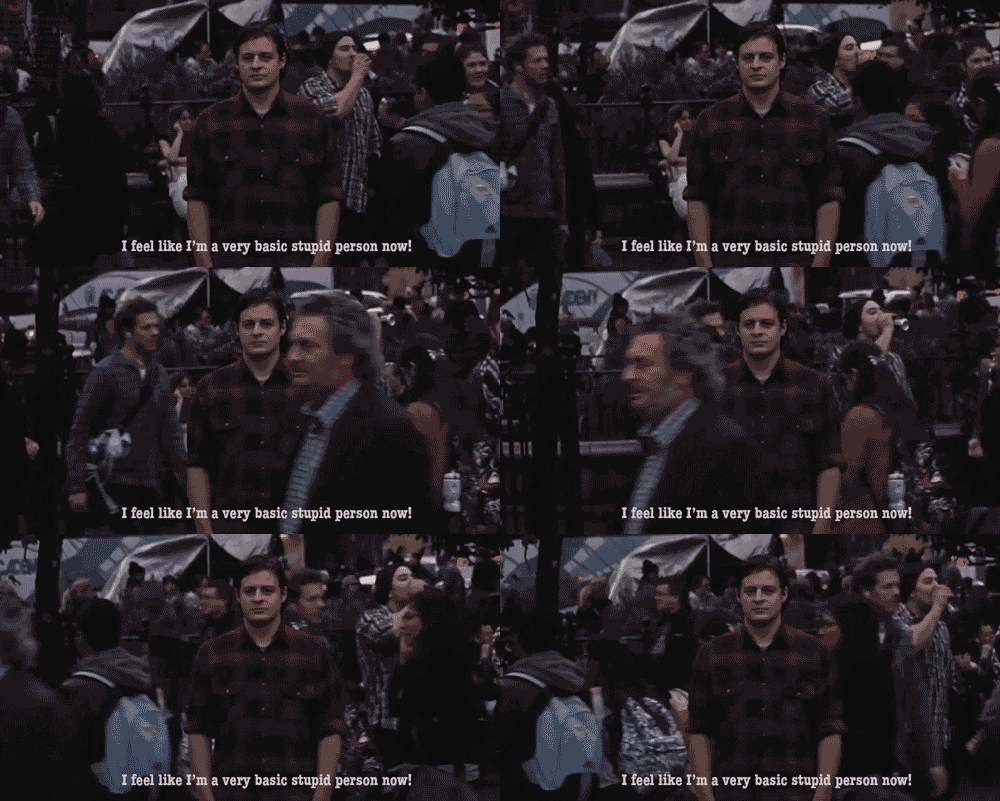
    Paul Miller tells me that being disconnected from the web for a year has left him feeling stupid. He talks about how initially being disconnected felt like a mystical experience, after a while it became normal and towards the end it made him like ‘a failure. I felt like I was giving up once again. But I knew the internet was where I belonged.’

    His main learning was that connecting with other human beings without the web was hard and he did not have the resilience or tenacity to do this without it. I was left thinking that so many of these type of experiments have more to do with the personality of the individual undertaking them than with what they can teach us about the consequences of the way we use the web.

    As I listen to his perspective on the film, I compare it with the way I handled my digital retreat over the holidays just gone.  I was not focussed on disconnection because ‘it’ is causing me harm (as was Paul’s narrative from the start) but on how is it possible to be in the digital world in stillness? Our chosen frame of mind going into this kind of experiment matters so much. Paul concludes ‘I won’t have as much time to read or introspect or write the great American sci-fi novel. But at least I’ll be connected.’ Of course, he had the time to do all of that during his year offline, but instead he slept all day and played video games all night. This is not said in judgement, it is said to highlight that it is the inner not the outer that determines what we do with our technology or without it.

    With a frame of ‘how can I make it work?’ or ‘how can we preserve the best of x and still do y?’ There is no need for any extreme detox or cold turkey as we live each day in resentment. If we go cold turkey to avoid ‘harm’, we move away from the ‘thing’ and are still defined by the ‘thing’ in its absence. We miss it and still cling to it. I am reminded giving up smoking except for that last cigarette at the end of the day. I spent all day thinking about that last cigarette.

    In Paul’s case the Internet defined him, his associative trails online was who he was and importantly defined him as a social animal. Away from it he met his shadow and did not like it. And rather than take a look in the mirror, he found not-wifi-dependent distractions. He was not himself.  In some ways, I too believe that we are our associative trails online. I also believe that the identity we bring to a mediated environment follows a simple law: Garbage in, garbage out. Or stillness in, stillness out. Simple in a way.

    This collective and individual memory in the internet era has a potential that does fascinate me and is spoken to in the film. Our self narrative is anything but objective and objective data collection over years and over platforms can offer a view of the self that has to potential to surprise us and challenge our blind spots. Another voice from the film,

    “Keeping track of yourself seems innately important – if I measure the self in the world I get to see the self you never get to know otherwise. If I collect enough data I can get to understand who that unseen self is.”

    That edge between ‘delight and discomfort’ that Charlie Brooker speaks to in the series Black Mirror, is where the potential for exploration might be. Our espoused theories of  mind and our theories in use are quite often poles apart, psychology warns. If is possible, as the film suggests, that my computer knows more details about me than my mother, that it knows you better than you know yourself, then may be, just may be, if we put this data together it could surprise us. So there is a push-pull dynamic here. Do I want to see my shadow? Paul’s case study seems to suggest: no. Yet there is an allure to seeing the unseen. What if in gathering all this data together I learnt about patterns I have not seen in my actions to date? The film tells us about data artist Liesl Capper who believes that

    “the self we put on the web is more real than real, I am confined by nature but on the web I can be anyone, a true representation of what is in my soul and mind.”

    She suggests that we are inexorably heading in a direction where the self is ‘more and more abstracted, thinking about thinking as opposed to doing’ because of digital mediation. She suspends judgment as to the value of this, but sees it as inevitable. Do we want to see our reflection warts and all?

    I go back to Black Mirror. In the episode ‘The entire history of you’ we learn about he Grain,

    “what if you had a kind of Sky Plus system for your head, so you could rewind and replay memories at will? You’d never forget where you left your keys again, for one thing. And it would be great for winning arguments. But it might not be brilliant news for the health of your relationship. After all, how much do you actually want to know about each other?”


    The grain allows for what In Limbo only hints at. Total recall. Dinner parties where your day can be the subject of a ‘re-do’ over dinner. Delight and discomfort. In Limbo sees the delight more than the discomfort and goes as far at to speculate about the Internet as a religion. We come to it looking for cybergrace. In Limbo presents the views of Jim Gilliam who finds it hard to connect with old religions yet holds certain moral values he sees as coming from the Internet. He suddenly realised that,

    “my value system and my morality was coming from the internet. Everything I value – sharing, connecting, openness, transparency and authenticity – everything I value. The internet is my religion.”

    In the world of the Grain in Black Mirror there is no privacy, yet no big corporation is taking it away. It is human beings giving it up willingly for the comfort of total recall. The comfort of not having to even try to remember anymore.  As David Whiteland says: ‘You should never underestimate the power of comfort. To our everlasting discredit, we owe our utter dependency on technology to our inability to resist it.’ In Limbo picks this theme up too. George Dyson,

    People always say if we turn our computers off it [any intelligence] disappears, therefore we are still in control. But can we turn our computers off? Would they let us? We don’t know.

    Agency here is put on the computer, but the more interesting question is: Can we turn our computers off? In the sense that even if we want to we cannot bring ourselves to be without them. Who can resist the allure of total recall? Not the people at Internet Archive,

    We see the web as collective memory here at the internet archive. What we do is in concert with religion. A coming together. Every light that blinks on our servers is someone uploading or downloading something. Three million people a day using these machines.

    Amen.

    I recall, with my faulty organic memory, that after 20 years of meditation and retreats only 2 years ago could I bring myself to leave my smart phone in the lock up at the monastery as we are requested to do. I rarely used it but I could not bring myself to be without it.

    What are the unintended consequences of a world where ‘digital remembering is the default and it is forgetting that is often forgotten’? Even in death we might be able to remember In Limbo enthuses about this very possibility. Black Mirror paints a different picture.  The episode that speaks to this is ‘Be right back’ where Martha loses Ash, is grief-stricken and finds herself rebuilding an artificially intelligent Ash from the collected computer data of his whole life,

    “Over the following days, Martha is overwhelmed by grief, and soon discovers that she is pregnant. Becoming emotionally unstable, she responds to the artificial Ash’s e-mail. She starts to communicate with him through instant messaging, and informs him of the pregnancy. She then uploads videos and photos of Ash to the service’s database, and the service duplicates Ash’s voice to talk to Martha over the phone. Martha allows herself to believe that she is talking to her dead partner, and over the following weeks she talks to the artificial Ash almost non-stop, keeping him updated regarding the pregnancy. After Martha accidentally damages her phone and has a panic attack when she temporarily loses contact with the service, the artificial Ash tells her about the service’s next stage, which is still in its experimental phase: a body made of synthetic flesh that the program can be uploaded onto.”

    To our everlasting discredit, we owe our utter dependency on technology to our inability to resist it.

    What do we lose when we remember everything? Ironically, I see that in our transition from the transient to the permanent (from fallible human memory to exhaustive digital memory) we are faced with our own impermanence.  We could choose to see how a digital self that is ‘more real than real’ yet more about ‘thinking than about doing’ ‘makes it more obvious to us how our own life is finite but the world goes on’. In Limbo ends here.

    The fact of impermanence, so strongly resisted in our culture, seen in flashing server lights as we watch our immortal digital selves live on.

css.php